Dog Losing Hair But Not Itchy? 7 Non-Inflammatory Causes
Hair loss without itching narrows the possibilities — it's probably NOT flea allergy or mange. Here are the 7 causes of non-itchy dog hair loss and when to see a vet.
Published 2026-04-19

Your dog is losing hair — in patches, on the tail, or spreading across the flanks — but they're not itchy, not scratching, not uncomfortable at all. You might be tempted to think "it must not be serious" since there's no distress. Actually, the LACK of itching is one of the most useful diagnostic clues you can give your vet.
Non-itchy hair loss narrows the list dramatically. It's almost certainly NOT flea allergy (intensely itchy), NOT sarcoptic mange (intensely itchy), and likely NOT most bacterial infections (at least moderately itchy). Instead, these are the 7 most likely causes.
1. Ringworm (Fungal Infection)
Despite the name, ringworm is a fungal infection, not a worm. It causes circular patches of hair loss with scaly edges, and it's often NOT itchy — especially in early stages. Puppies, kittens, and immunocompromised animals are most at risk. Critical: ringworm is highly contagious to other pets AND to humans, and fungal spores persist in the environment for 18+ months. Diagnosis: fungal culture or PCR. Treatment: 4-12 weeks of topical antifungal shampoo + oral antifungal medication + environment decontamination.
2. Demodectic Mange (Demodex)
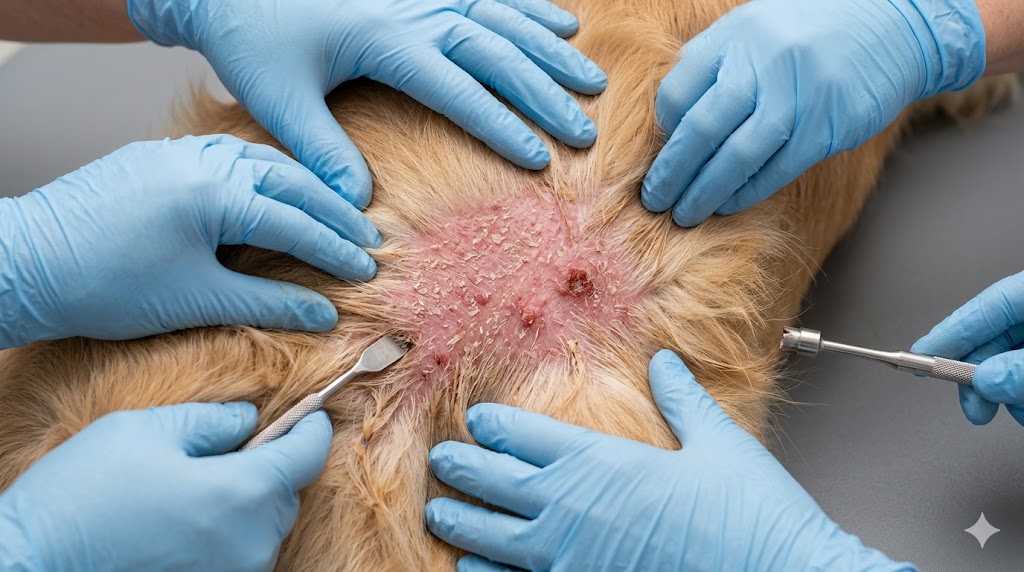
Demodex mites live on most dogs' skin without causing problems. In some dogs — especially puppies under 18 months and immunocompromised dogs — they multiply and cause patchy hair loss. Classic pattern: starts around the eyes, muzzle, and front paws; patches are usually NOT very itchy; skin may be slightly red underneath. Diagnosis: skin scraping under microscope shows the mites. Treatment: modern flea/tick preventatives (Bravecto, NexGard, Credelio) actually kill demodex too — very effective. Most localized demodex in healthy puppies self-resolves; generalized demodex needs treatment.
3. Hypothyroidism (Underactive Thyroid)
Thyroid hormone is essential for healthy hair cycling. When thyroid levels drop (common in middle-aged dogs 4-10 years, many breeds but especially Golden Retriever, Dachshund, Cocker Spaniel, Beagle), hair follicles stop cycling properly and fur thins. Classic pattern: "rat tail" (bald tail), symmetric thinning across the trunk and flanks, sparing the head and legs initially. Associated signs: weight gain despite normal appetite, lethargy, cold intolerance, dull coat, ear infections. Diagnosis: thyroid blood panel (T4, free T4, TSH). Treatment: daily thyroid hormone replacement (levothyroxine) — inexpensive, and hair usually regrows in 3-6 months.
4. Cushing's Disease (Hyperadrenocorticism)
Cushing's is excess cortisol production, typically from a pituitary tumor. Common in senior dogs 9-11 years; predisposed breeds: Poodle, Dachshund, Boxer, Beagle, Yorkshire Terrier, Boston Terrier. Classic pattern: symmetric thinning across trunk and flanks, THIN fragile skin that may tear easily, calcinosis cutis (gritty white patches — calcium deposits). Associated signs: pot-belly appearance, increased thirst and urination (often dramatic), excessive panting, muscle weakness. Diagnosis: ACTH stimulation test or low-dose dexamethasone suppression test (blood tests). Treatment: trilostane (Vetoryl) daily — responds well with monitoring. Hair regrows over 4-8 months.
5. Seasonal Flank Alopecia (SFA)
A specific and surprisingly common cosmetic condition. Bilateral symmetric hair loss on the flanks (sides of the body between ribs and hips) appears in late fall/winter, often regrowing in spring/summer. May recur yearly. Predisposed breeds: Boxer (classic), English Bulldog, French Bulldog, Schnauzer, Airedale Terrier. Cause: incompletely understood; appears related to changes in daylight affecting melatonin production. Diagnosis: breed + symmetric flank pattern + seasonal timing + bloodwork to rule out endocrine disease. Treatment: often none needed; melatonin supplementation (3-6 mg daily) helps some dogs regrow faster.
6. Alopecia X (Cause Unknown)
Also called "black skin disease" or "adrenal-sex-hormone imbalance." Typically affects plush-coated Nordic breeds: Pomeranian, Chow Chow, Keeshond, Siberian Husky, Malaysian. Pattern: gradual symmetric loss starting on the hind end and progressing forward; underlying skin often darkens (hyperpigmentation). No itching, no systemic signs. Cause: unclear — thought to involve hair follicle growth arrest. Diagnosis: exclusion of all other causes through bloodwork and biopsy. Treatment: variable success with melatonin, deslorelin implants, neutering (especially in intact males). Not dangerous but frustrating — often cosmetic only.
7. Pattern Baldness (Genetic / Breed-Specific)
Certain breeds have genetic pattern baldness that's entirely normal for their breed — not a disease. Examples: Chihuahua "pinnal alopecia" (thinning on ears/ear flaps); Dachshund "pattern baldness" on the chest/belly; Whippet, Italian Greyhound, and Chinese Crested also have breed-typical thinning. Appears at adulthood (1-3 years), doesn't progress aggressively, no skin changes, no itching. Treatment: none needed — it's normal for the breed.
Bonus: Post-Surgical Clipping Alopecia
If your dog had surgery and the area was shaved, sometimes the hair doesn't grow back — or takes 6-18 months. More common in Huskies, Malamutes, Chow Chows, and other double-coated breeds. Not itchy, no skin changes. Most eventually regrows; some dogs have permanent thinning at the clip site.
When Non-Itchy Hair Loss Is Actually Urgent
The following combinations need same-week vet visits:
- ✓Symmetric body-wide thinning + increased thirst + pot-belly = Suspected Cushing's
- ✓Rat-tail appearance + weight gain + lethargy = Suspected Hypothyroidism
- ✓Puppy with hair loss around eyes spreading to other areas = Possible generalized demodex
- ✓Any non-itchy hair loss + weight loss + appetite changes = Systemic illness workup
- ✓Hair loss with bruising or pale gums = Possible coagulation disorder or anemia — urgent
The Common Thread: Bloodwork Is Often Needed
Most non-itchy hair loss causes require BLOOD WORK to diagnose definitively — you can't tell Cushing's from hypothyroidism from Alopecia X by looking at the dog. This is the key difference from itchy hair loss (which is often fleas, allergies, or mange — visually apparent). If your dog has non-itchy hair loss, expect your vet to recommend: thyroid panel, ACTH stim test (for Cushing's), sometimes adrenal ultrasound.
Not sure which pattern you're seeing? Upload a photo — our AI identifies the pattern and tells you which of these 7 causes is most likely, plus whether bloodwork is needed.
Identify the Hair Loss Pattern
Upload a photo — AI ranks the likely cause from pattern alone and flags when blood work is needed.
Disclaimer: This article is for informational purposes only and is not a substitute for professional veterinary advice. Always consult a licensed veterinarian for diagnosis and treatment of your pet's health conditions.